Everyone’s talking about AI – Artificial Intelligence right now, particularly as it relates to work. It’s reshaping how we work, what skills matter, which jobs exist, and how decisions get made. Every new development wants you to be excited, but a lot of people are quietly anxious, and most are trying to figure out what it means for them.
Underneath it all is a very human question:
What is it we need from each other? That AI can’t replace?
I don’t have a complete picture of that, nor I’m sure does anyone else. But I’ve been thinking about a different kind of AI in the workplace – one that doesn’t run on data, doesn’t hallucinate, and can’t be automated. It runs on human interaction.
Specifically, on what happens when humans stop trying to control the conversation, or the outcome, and start deeply listening and paying attention to each other.
Not Artificial Intelligence. Applied improvisation.
This AI – Applied Improvisation takes the principles of improvisational theatre techniques – presence, listening, “yes and”, spontaneity, making others look good – and applies them in non-theatrical settings.
Imagine your leadership team – they have a pattern, don’t they? Someone speaks first. Someone defers. An idea is dismissed before it has a chance to breathe. And meetings – always the same.
Applied Improvisation creates new conditions that interrupt usual patterns and habitual ways of thinking and doing. Not because the usual way is bad, but because fresh approaches lead to innovation.
This version of AI is being used across MBA programmes, healthcare, business, and organisations globally. Using improvisation enhances our ability to listen, be present, and respond productively when things aren’t clear or fully formed.
It develops the capacity to stay with uncertainty rather than to quickly close. And it encourages a mindset for taking small risks, supporting and making others look good.
Attending a ‘Train the Trainers: Advanced Applied Improvisation’ Course in Sydney
This is where it came together for me. I recently attended the Train the Trainers: Advanced Applied Improvisation programme in Sydney with Raymond van Driel, Ted DesMaisons and Julie Trell, and I’ve been buzzing since.
Not because it was entirely new to me. I’ve been drawing on Applied Improvisation in my work for a while now, but because it deepened something I already knew had value and gave me so much more confidence in how and when to bring it in when working with clients.
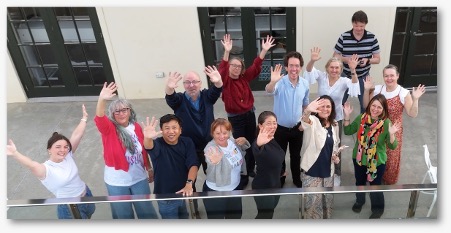
Our group came from across Australia with varied backgrounds and experience levels – some already using AI, others newer or not completely convinced.
We didn’t know each other, which was perfect for what we were there for, yet within a very short time, we became a collegial group, ready to dive in.
We were not just learning or theorising about Applied Improvisation, but learning by using it, by being in it, which is the only way.
What surfaced?
It didn’t take long for my own habits to become visible. How quickly I wanted to shape or control what was happening, tidy it up, or steer it toward something I had mind.
Then I found moments when I caught myself doing something different: staying with what was offered a little longer, listening differently, and responding rather than directing.
The “yes, and” started to feel less like a technique and more like a genuine choice about how present I was willing to be.
It wasn’t about simply agreeing with everything, but about working with what’s there rather than what you think should be there.
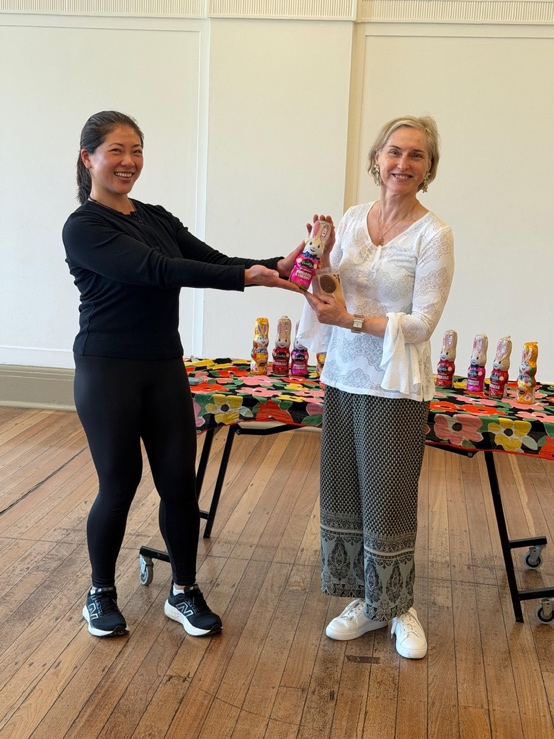
Susan presenting Cathryn with the Improv Bunny Oscar
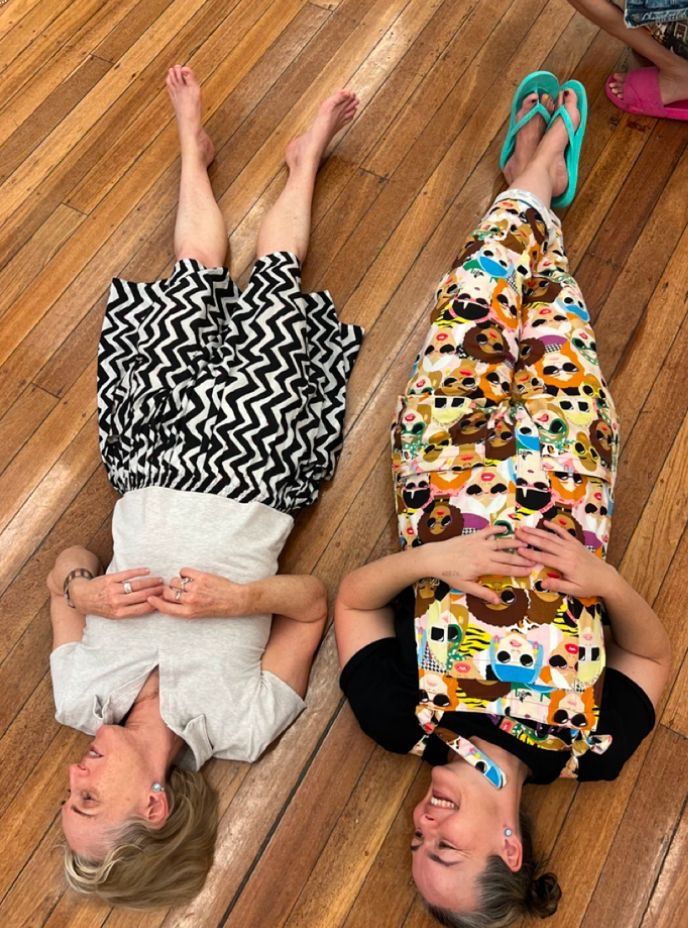
Fun and games – Erin and Cathryn laying down on the job
Why this feels so timely
Returning gratefully from my immersive experience and deep in reflection, I noticed that the 2026 Australian Financial Review BOSS Best Places to Work list had been published.
As I read the commentary, two worlds intersected for me with clarity.
The process of finding the best places to work highlighted what people are genuinely experiencing in the workplace right now.
The desire to feel connected, and at the same time, confident about the skills they’ll need as things keep shifting. That culture and business performance are not competing priorities, they reinforce each other.
Alongside that, a concerning bigger picture of the human cost of relentless change, the pace of it, constant restructuring, and the cognitive and emotional load on people.
Sometimes the pace creates real energy and momentum. Sometimes it wears people down.
Leading to a lack of connection, clarity, and meaning in its wake.
Applied Improvisation makes sense in the workplace
The BOSS piece spoke about energy and rhythm, how work feels day to day, and how clarity and communication shape people’s experience over time.
This is framed as a leadership responsibility, and it is, but what struck me reading it was that these things aren’t really leadership challenges in the way we usually frame them. They’re not solved by a better strategy or a clearer chart.
These challenges occur in the small moments.
Who gets interrupted? Whose half-formed idea gets built on and whose gets set aside.
Whether there’s genuine space to think together, or whether every conversation has already been decided where it’s going before it starts.
That’s where learning and applying the skills embedded in Applied Improvisation offers something unusual and needed.
It invites people to be part of the process, to lead and follow, to offer and accept, to trust each other, build on ideas, make each other look good, tolerate ambiguity, lean in with half-baked ideas, take risks, stretch and get comfortable making errors.
It challenges business as usual habits.
Our 1 in 100-year Experience
Toward the end of the Train the Trainer group’s time together, we found ourselves on the Bondi Pavilion balcony watching a 1 in 100-year ocean swell.
It was wild and genuinely awesome.
The kind that makes you totally present to the moment.
Which is exactly the gift and skill of Applied Improvisation.
It struck me that this is exactly what the world needs more of right now – genuine presence and connection.
The capacity to stop managing the situation and just be in it. To be moved by something. To let what’s really happening surface before judging and deciding.
I came away with new tools, a deeper sense of where applied improvisation adds value, and a greater awareness of how I show up and the impact that has on the people around me.
The bonus take away is leaving with new friendships and people who I know can support me and I can support them.
I recognise in the mix of all of this is another “AI” – Artful Inquiry
The methodology that underpins my work, creates conditions for connection, creation, and innovation.
The convergence of these ways of working feels very timely.
I’ll explore this more next time.
I’m curious…what are you noticing?
In your workplace right now, where is the pace of change energising people, and where is it starting to wear overwhelm them?
Where are ideas being built on, and where are they dismissed?
What happens when there isn’t a clear answer, or something unexpected happens?
What would be different and possible in your workplace if people had the opportunity to experiment and play, which is the heart and soul of Applied Improvisation?
If this sparks curiosity and interest, I’d love to have a conversation about what this kind of work can look like in your context.
If you get the sense that there is value here for the people in your business, there’s so much we can work with.
All you have to do is reach out with a “Yes and” response, and we go from there.
Enjoy the Bondi Swell