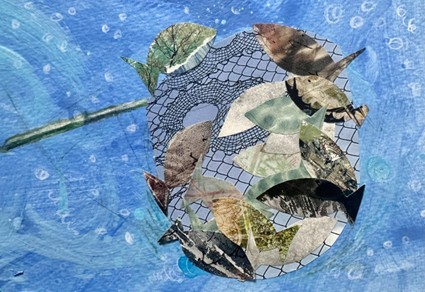
Artwork: Cathryn Lloyd
There are times when we can hold an idea confidently, but once we share it aloud, something gets lost in translation. The picture in our mind doesn’t match the one in theirs. The meaning gets stuck somewhere between our thoughts and someone else’s understanding.
Recently, this issue arose again during a mentoring and coaching session with Edilita, an entrepreneurial changemaker in Africa and a biomedical engineer I am mentoring as part of the beVisioneers Mercedes-Benz Fellowship, a global program for young eco innovators. She described her project well in thoughtful, considered detail, yet I still couldn’t quite picture what it would look like in practice.
Then Edilita did something I often do in my work with my Shift Your Thinking cards. She shared an image that represented the heart of her idea.
Suddenly, everything became clearer because we could both see it. As Edilita held her image up to the screen, she talked me through her process. She was able to describe her project in a way that fully engaged me. The image helped bridge the gap. I went from not really grasping the concept to seeing it and having a much clearer sense of her project and the challenges she faces.
The clarity of that moment reminded me of a story Richard Branson once shared. After a board meeting, one of his directors asked whether he understood the difference between gross turnover and net profit. When it became clear he didn’t, the director picked up a marker and drew two simple images: a wide blue ocean and, inside it, a net filled with fish.
“The ocean is your gross turnover,” he said.
“And the net with the fish – that’s your net profit.”
The picture did what the words couldn’t.
Branson understood immediately and later reflected that this kind of explanation worked well for him because he processes the world visually. As a person with dyslexia, he considers his unique creative thinking as his entrepreneurial superpower, enabling him to notice patterns and possibilities that others might miss. But that kind of thinking becomes powerful only when it can be shared, and images often provide the bridge.
What does this tell us?
- We don’t all learn in the same way.
- Some people are good with numbers.
- Some people work better with images, patterns, stories or objects.
For many neurodivergent thinkers, visual or spatial ways of seeing the world offer a clearer path. Because there isn’t one way to know or communicate, there are many.
When people draw, map, model, sketch or prototype, ideas that are hidden in words, language and conversation are free to surface in new ways. This approach, which I call Artful Inquiry, was the main focus of my doctoral research, where I explored how visual processes help individuals and groups uncover what’s hidden, co-create meaning, and develop a clearer shared understanding of their goals.
When we returned to Edilita’s project later in the session, something had shifted. The image didn’t just help me understand, it helped her see her own idea with more clarity and confidence.
That’s the real power here.
Visuals help us surface what we know, express what matters, and share understanding in ways that words alone sometimes can’t.
If you’re curious how visual tools could support clearer thinking, stronger communication, or more shared insight in your own context, you could take a look at the Maverick Minds Shift Your Thinking cards. I’d love to help you find the image that makes things click.
Let’s explore what your ideas look like.
As a side note, the header image in this story is my own visual collage interpretation of Richard Branson’s story.