I’m currently working on a two-day workshop with a new team. Our focus: team development, project development, and strategic thinking.
As part of the design process, I’ve been thinking about how people make sense of complexity together and how we create the conditions for new perspectives, creativity and connection to emerge.
That reflection led me back to a story about Richard Branson attending a board meeting when he realised he didn’t understand the difference between gross and net profit. Over the years, he’d done a pretty good job at camouflaging his dyslexia, but he could no longer keep it a secret.
A colleague kindly drew him a simple picture. He coloured a piece of paper blue to represent the ocean and put a net in the ocean with fish in it. He explained that the fish in the net represented net profits, and the rest of the ocean represented gross turnover.
That was Branson’s “aha” moment, both in terms of understanding a concept and seeing his financials in a whole new light. It’s a moment he’s often spoken about in terms of how he has come to see his dyslexia as a superpower, one that gives him different ways of processing information, seeing the world and generating ideas.
Making sense through images
His story has always resonated with me. For a start, I’m not a natural with numbers or spreadsheets.
Second, I find images a valuable way of making sense of things. So much so that I create them as well. As part of my MM365 project, where I created an artwork every day for a year, I created my own version of Branson’s story as an image.
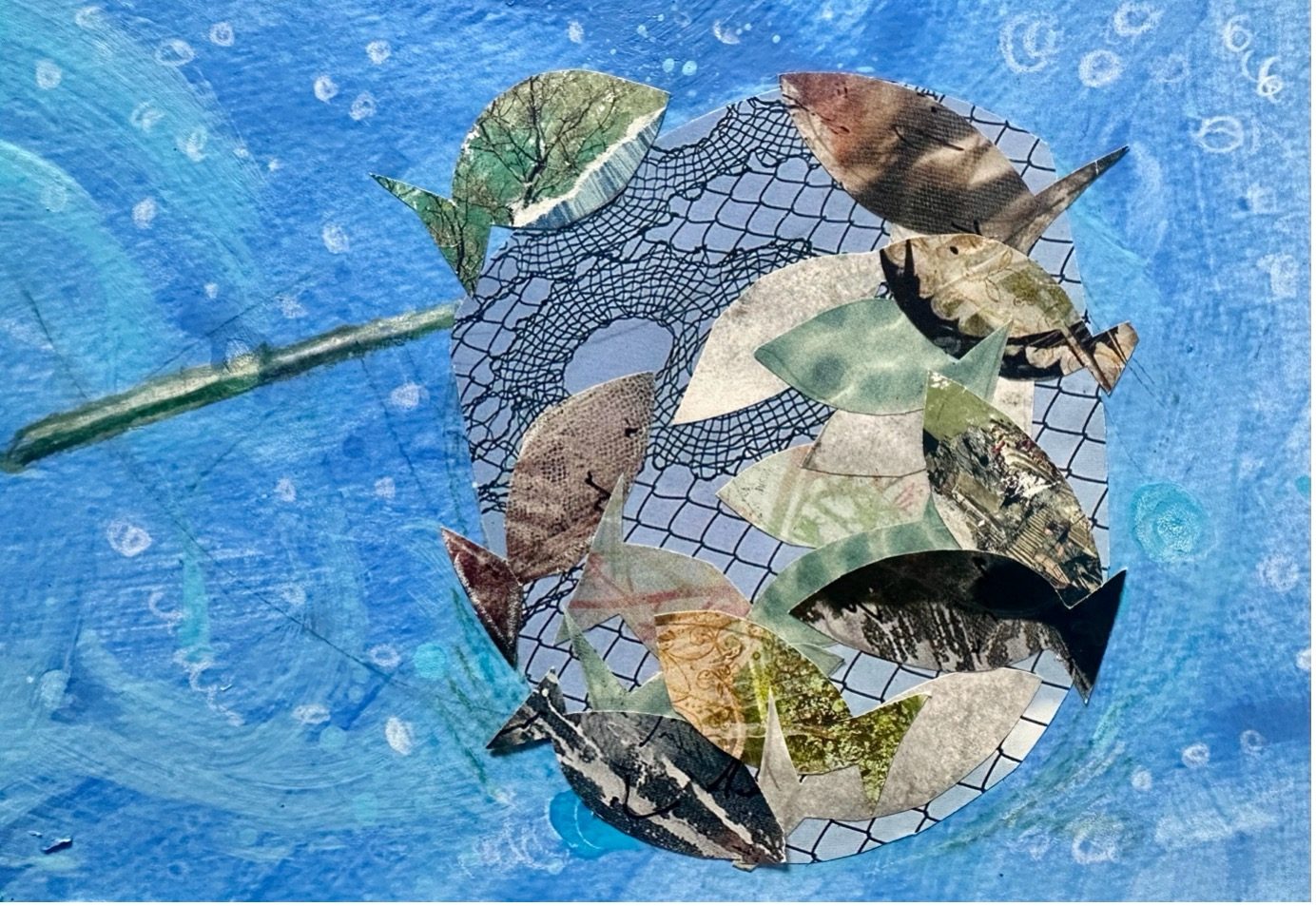
The Art of Net Profit & Gross Turnover – artwork Cathryn Lloyd
My own “aha” moment
When my colleague Geof Hill invited me to write the foreword to his upcoming book, The Politics of Artful Inquiry: Spaces for Empowerment, it prompted me to dig more deeply into my artful facilitation philosophy and processes.
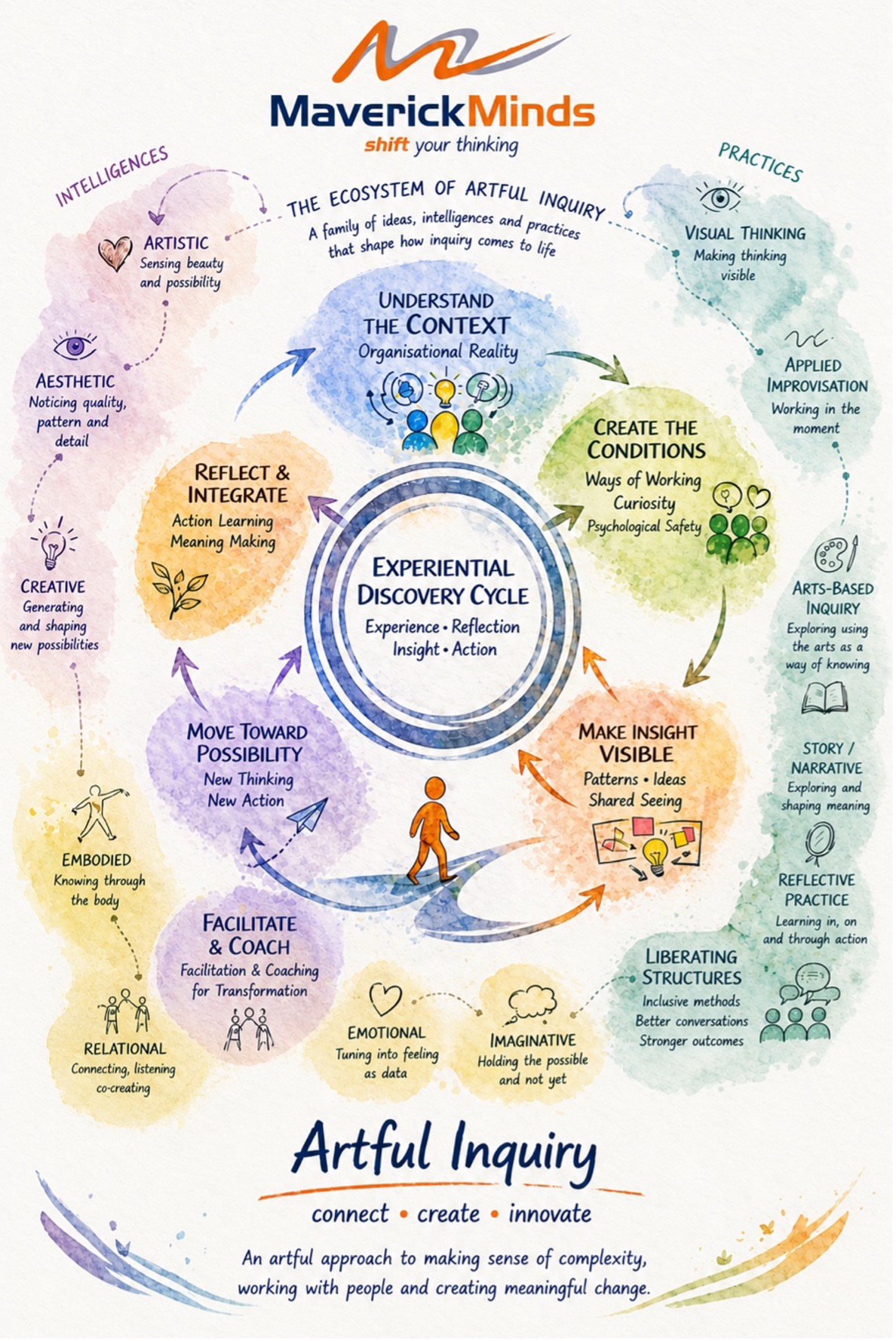
In doing so, I found myself wanting to make sense of it visually as well. The idea of creating an image to visually conceptualise Artful Inquiry felt like a natural progression.
It became a way of seeing the work differently, noticing the connections between ideas and practices that often sit beneath the surface, helping scaffold how we think and work together.
Not only was this valuable for me, I thought it could help Maverick Minds clients visualise how we can work together and the different ways we can approach their inquiry.
The image represents Artful Inquiry not as a linear process or fixed approach, but as a responsive and evolving ecosystem of approaches that can be curated and drawn on depending on the people, purpose and context.
What also became clearer to me while working on the image is why this way of working matters right now.
We’re operating in increasingly complex environments. AI is becoming part of everyday work life. Information is everywhere. Yet many of the challenges people are dealing with are not simply technical.
They involve judgement, relationships, perspective, communication, discernment and the ability to work with uncertainty.
This is where Artful Inquiry comes in. Not as a linear system, but as an ecosystem of approaches that can help create the conditions for different perspectives, experimentation, connection, creativity and collaboration.
It offers different entry points and approaches that can be drawn on depending on the situation.
Artful Inquiry brings the creative, critical and relational into play, which is often what’s needed in complexity and change.
What does this look like in practice?
What this looks like in practice is different every time, as each situation and group brings its own context, pressures and needs.
Whether we are trying to make decisions, collaborate, imagine or innovate, we need the space and support for that inquiry to unfold, to see ourselves and the situation in a new light.
To make the invisible visible and the intangible tangible.
This is what sits at the heart of Artful Inquiry.
And it’s what has led me to visualise Artful Inquiry through the image I’ve shared here. It brings into view the elements and ways of working that sit within it.
An invitation to inquire
As you think about your own context, where might a more artful approach make a difference?
If you could create an image of how your team, project or organisation is currently working, what might it reveal?
What might suddenly become clearer?
I’d be happy to explore how we can bring these strategically creative ways of thinking and working into your world.