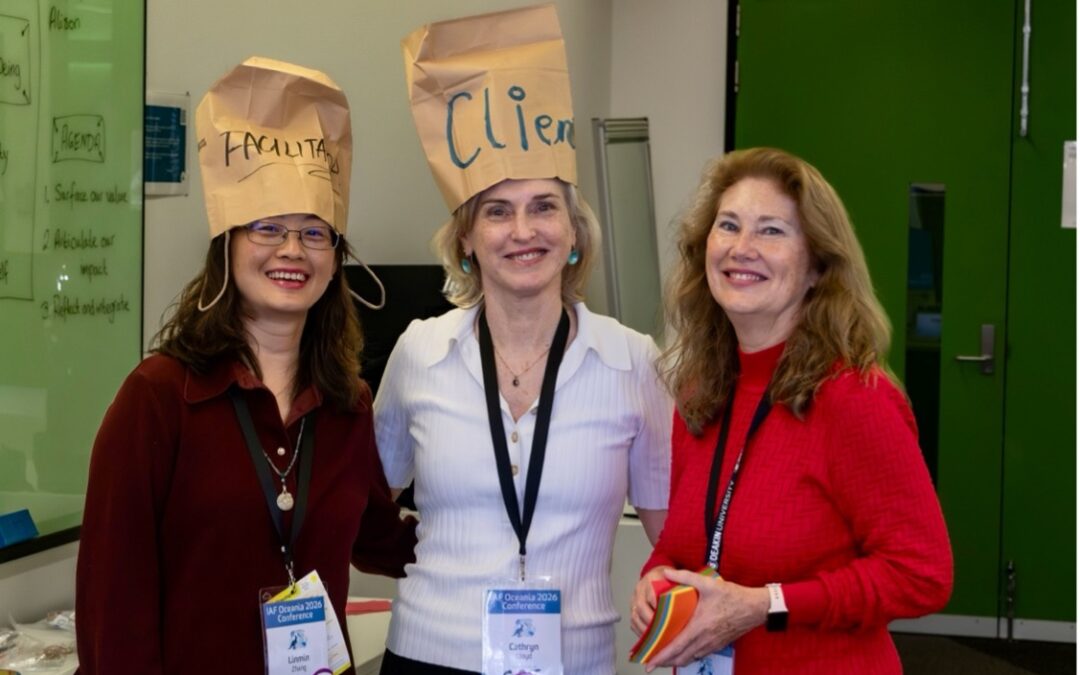
Linmin, Cathryn and Alison – IAF Conference 26
How do you talk about the value of your work? And how would someone who’s worked with you describe the difference it made to them?
I suspect many of us find it easier to talk about what goes into our work than its impact for our client. I might talk about designing a session so everyone has a chance to contribute. However, someone in the group might say, ‘We finally talked about the issue we’d been skirting around for months.’
So, what actually changes after that conversation? What’s the value in having it, and how does it make a difference to the person, their team and the wider organisation? These are the value and impact type conversations we need to have with our clients.
Alison Gitelson, Linmin Zhang and I have been comparing notes on our facilitation for a while now. Our work takes place in different countries and cultures, and we often find ourselves circling back to the question: how do we talk about the value and impact of facilitation in a way that makes sense to the people who engage us?
We saw our conversations reflected in SessionLab’s State of Facilitation 2026 report, which looked at the gap between how facilitators describe their work and how clients talk about the difference it makes.
When the call for sessions went out for the recent IAF Oceania Conference in Geelong, we saw an opportunity to explore that gap with other facilitators and put in an expression of interest for a session we called Articulating Value and Impact: Transforming How We Align and Collaborate with Clients.
What changes when we change hats?
Wearing our facilitator hats, we asked our colleagues in the session to consider the value they add when they work with a group. On the first wall went things like holding uncertainty, asking ‘dumb’ and curious questions, and making room for others to ask theirs. There was also the work of zooming in and out. When does a detail need more attention? When does the group need to step back and see the bigger picture? Whose perspective haven’t we heard yet?
Then we put on our client hats. How might someone who engages a facilitator describe the benefit or impact? Up on the second wall went trust, clarity, alignment and shared understanding, alongside ‘we feel safe to share mistakes and ask for help’.
For someone in the team we are working with, that might mean feeling more supported. Their manager might notice that problems get raised earlier and things don’t get stuck for so long. Exploring what these words mean to different people helps us clarify what each person hopes will change.
Someone wrote retention, and that took us beyond what happens during the session. How people work together can be a reason good people choose to stay.
We’re bringing people together so that…
When we put our facilitator hats back on to talk about impact, some familiar language returned. On our third wall was ‘building capability so that…’ So that people can do what together? One example on the wall made it concrete. When people know who’s doing what, they can spend less time doing the same work twice.
I’m currently working with a volunteer network that is refining its strategy and action plan. We’ll explore what people want to achieve as a network, so that they can agree on what to prioritise and what they’re prepared to commit to together. What we’re talking about here is alignment and clarity of purpose.
That’s where shared intention comes in. I want to know what the client is expecting me to help with and what they hope will be different afterwards. I also want them to understand my intentions and expectations.
While I’d like to speak with everyone involved, that isn’t always possible. Wearing my facilitator hat, I’m paying attention to the expectations people bring into the room, especially those I haven’t met beforehand, how these sit alongside the purpose and decisions already agreed and how we create space for what may emerge at the time.
Removing barriers
In a recent facilitation workshop, I asked participants what they thought facilitation was before I offered any definitions. One definition focused on removing barriers so people could share and learn from each other. It made me think of Adam Kahane’s Facilitating Breakthrough and a question I often ask in my work.
What’s getting in the way of people working well together?
I sometimes ask myself what else I could call facilitation, then wonder why I shy away from the word. Perhaps it’s hard to define because the work itself often begins with uncertainty. Getting clarity on a situation can take time, and people often have different perspectives.
People may come into the room with quite different ideas about what the problem is or what needs to happen. Part of my work is to listen and create the conditions with them to build trust, talk openly about what matters and get clearer about what they can do together. From there, they can make decisions they’re willing to stand behind and take responsibility for what happens next.
If you’ve worked with a facilitator, whether that was me or someone else, what difference did it make for you, your team or the people you work with?
If you were bringing people together now, what would you want a facilitator to help you do? How would you finish the sentence ‘We’re bringing people together so that…’?
I’d love to hear your thoughts. Just reply.
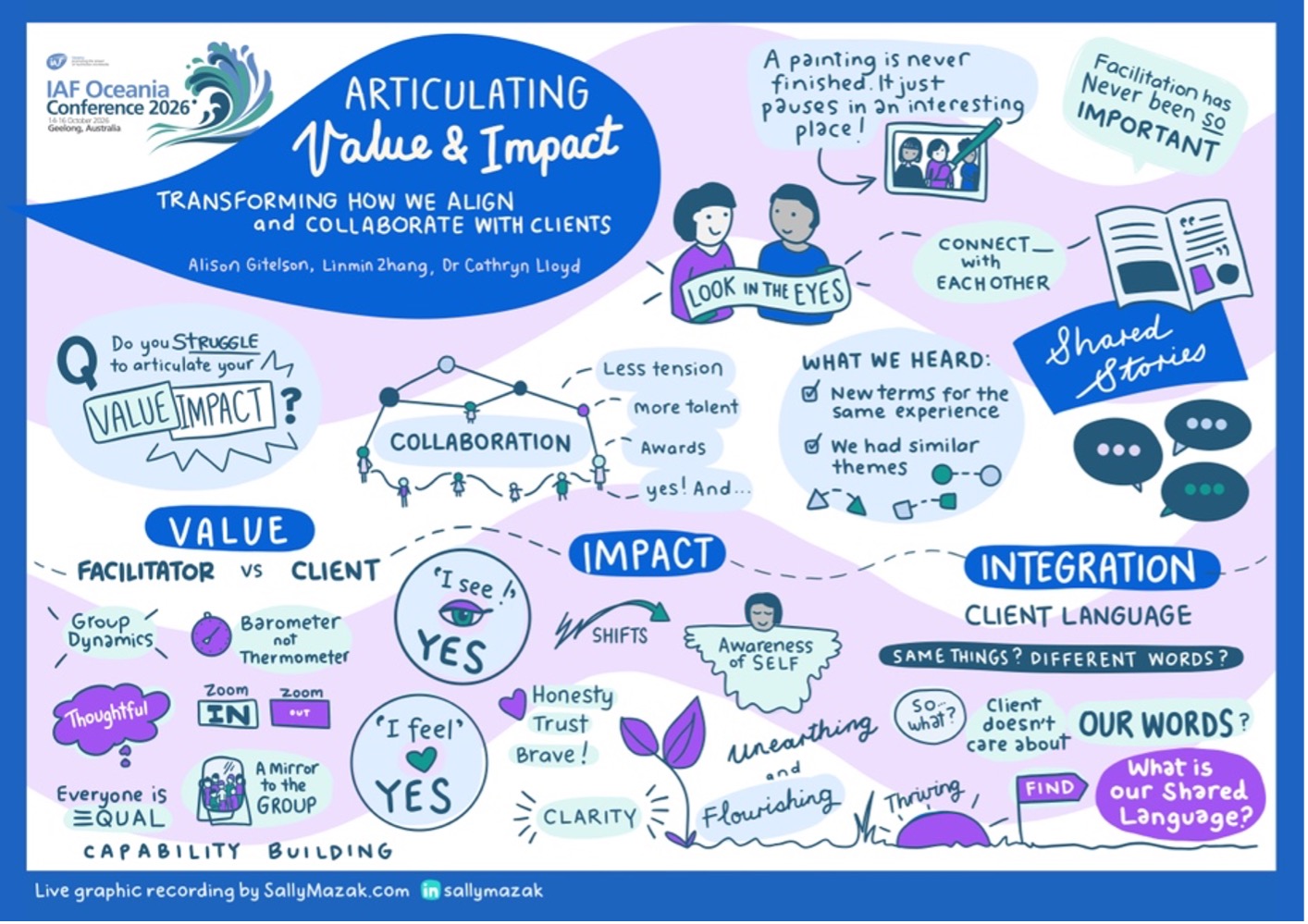
And the team from Graphic Recorders Australia partnered with the IAF to create both digital and analogue recordings, adding another artful dimension to the conference. We were delighted to see our session through Sally Mazak’s eyes in her digital graphic recording. What a great artefact to come away with. It gives us a way to revisit the conversation and notice connections we might have missed in the room.
Take a look at Sally’s digital graphic recording of our session