
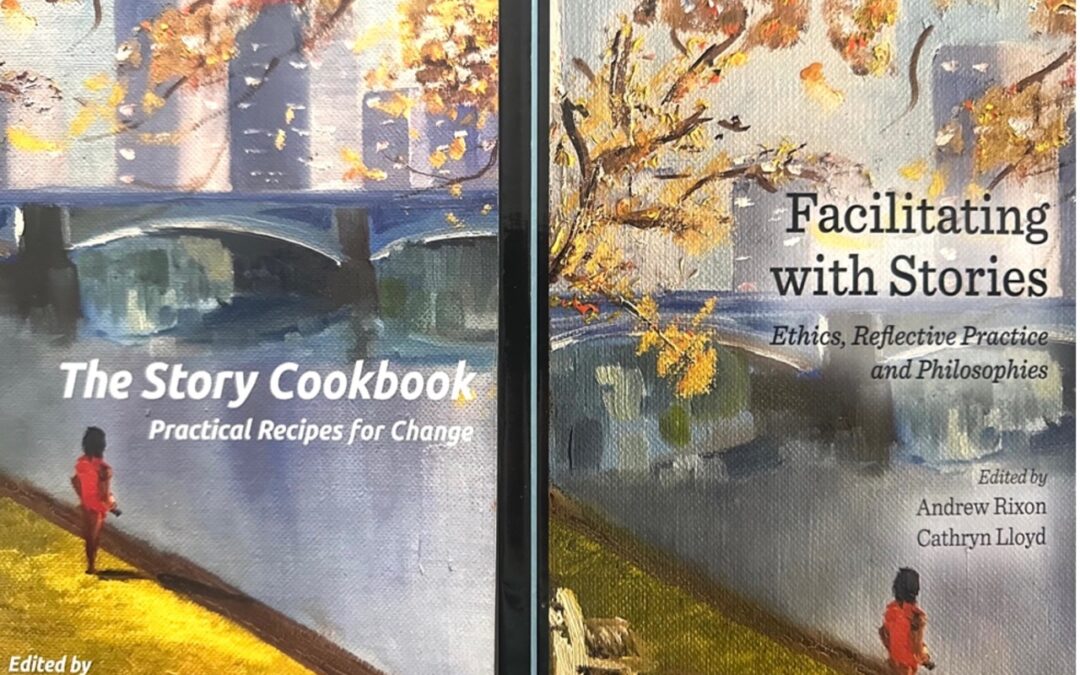
What better way to begin a conversation about stories than with a story told through art?
When Andrew Rixon and I recently joined the IAF Book Club to talk about Facilitating with Stories, our co-curated collection of writings and experiences of facilitators worldwide, host Linmin Zhang began by asking us about the book covers.
The cover image comes from a painting I created years ago. Different sections of it now appear across four books in the collection, including the two Andrew and I worked on together: The Story Cookbook and Facilitating with Stories.
I love that the original painting has travelled in this way. Each cover contains only a section, offering a different view depending on what has been selected and brought into focus. Stories can be like that too. We never have the whole picture.
We are wired for stories
Ask people to tell a story and you can almost feel the intimidation arrive.
What story will I tell? Is it interesting enough? Does it have a point? Do I need a dramatic beginning, middle and end?
It’s strange when you think about it because we tell stories all the time. We talk about something that happened on the weekend, explain how a meeting went or share a moment that amused or frustrated us. We are homo-narrans, aka – story telling humans.
Some stories might seem bigger than others because of what happened or the meaning we place on them. But storytelling doesn’t have to begin with a grand narrative.
During the Book Club conversation, we talked about spontaneity and the living stories already emerging in a group. They can appear through an offhand comment, a shared laugh, an image or the different ways people describe the same experience.
One question I sometimes ask when working with groups:
What’s the most ordinary thing about you?
For example, I might share that I love cleaning and filling up the bird baths in my garden. It’s an ordinary thing to do, but something extraordinary happens – I get lots of feathered visitors, great entertainment, bird song, and stories to share.
It’s ordinary, but it still has a story. Easing the pressure can give people a much easier place to begin. I wonder what you might say or what members of your team might say if asked ‘what’s the most ordinary thing about you”.
Whose story gets heard?
Towards the end of our session, the conversation turned to the ethics and politics of using stories.
Whose stories are heard? Whose stories aren’t? Which stories fit comfortably with what a group already believes, and which ones challenge it?
Inviting people to share also comes with responsibility. Even an apparently simple question can take someone somewhere unexpected. People need to be able to choose whether they share, what they share and how much they want others to know.
This doesn’t mean we need to fear working with stories. They can help people connect, understand different experiences and see situations from another perspective. We simply need to pay attention to what we are asking, why we are asking it and what we do with the stories people entrust to the group.
Linmin and Andrew have more to come, too. They have a new book pubished, Narrative Leadership Development: Storytelling for Navigating Challenging Times. I’ve been joining their webinar series, as they and their fellow contributors explore this topic, and l look forward to reading the book when my copy arrives.
Linmin and I will also meet in person for the first time in October at the IAF Oceania Conference in Geelong, where we’ll be co-facilitating a session with Alison Gitelson on articulating the value and impact of facilitation.
The story continues.